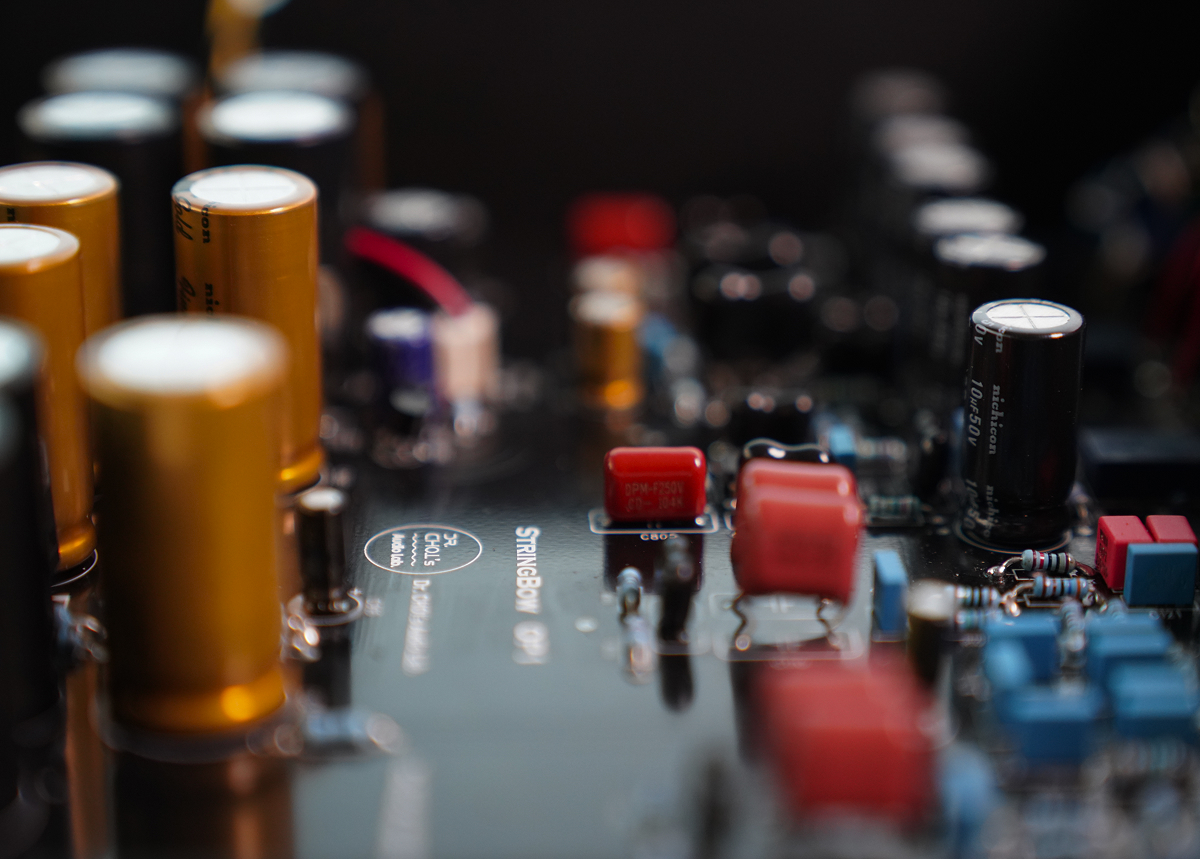
Music begins with tension.

STORY

Music begins with tension.
From the tension of a bow on a string comes vibration, energy and sound.
Stringbow was created from a fascination with this simple idea.
Stringbow was founded by Choi Yoonwook, an audio engineer, record producer and longtime audiophile. For more than thirty years he has pursued analog sound as a dedicated listener and has spent over two decades writing about audio. He is also the author of five books on the subject.
Over the years he has produced several vinyl records, including test LPs and Korean traditional music recordings, and has participated in the remastering of more than 200 vinyl albums. These experiences gradually shaped his interest in the relationship between musical expression and engineering precision.
Stringbow was created as a way to explore this idea through carefully designed analog equipment.

PHILOSOPHY

Music begins with tension.
When a bow touches a string, tension becomes vibration, and vibration becomes sound.
This simple phenomenon lies at the heart of musical expression.
At Stringbow, the goal of engineering is not to change music, but to reveal it.
Every design decision — circuit topology, signal connections, materials and construction —
is guided by a single principle: preserving the integrity of the analog signal.
Through precise engineering and careful listening, Stringbow seeks to reveal the energy and subtle tension within music.
The Tension in Music.

Fully Balanced Circuit Design

Fully balanced circuit architecture lies at the core of Stringbow design. From input to output, the signal path is maintained in a balanced configuration to reduce noise and preserve the integrity of extremely low-level analog signals. Balanced topology helps minimize the influence of external interference and ground-related noise, which is particularly critical in phono amplification. By maintaining signal symmetry throughout the circuit, balanced amplification can also contribute to a more stable and expansive soundstage, allowing music to unfold with greater depth and spatial clarity.

Welded Signal Connections

Stringbow cables are constructed using welding rather than conventional soldering. In soldered joints, the signal must pass through a layer of solder whose electrical and mechanical properties differ from those of the conductor itself. In extremely low-level audio signals, such interfaces can introduce subtle losses or inconsistencies. Stringbow employs precision welding techniques to create direct metal-to-metal connections, allowing the signal to be transmitted without additional interface layers. Welding a solid conductor to a connector is relatively straightforward. However, most analog signal cables use stranded conductors composed of many fine wires rather than a single solid core. Welding these multiple strands to a connector presents a far greater technical challenge. Stringbow has developed specialized welding techniques to achieve stable connections with stranded conductors. Depending on the conductor materials and connector geometry, different welding methods — including resistance welding and pulse arc welding, and ultrasonic welding — are used to form reliable and consistent signal contacts.

Magnetic Field Shielding

Phono signals are extremely sensitive to external electromagnetic fields. Motors, transformers and other electronic equipment surrounding a turntable can generate magnetic fields that induce hum and noise in low-level cartridge signals. Stringbow tonearm cables are among the first to apply ferromagnetic materials as part of their shielding structure — an uncommon approach in high-end audio cable design. By guiding and absorbing magnetic flux around the signal conductors, this structure helps reduce hum and suppress high-frequency interference. The result is a quieter background and improved clarity in low-frequency reproduction, allowing the soundstage to emerge with greater depth and stability.

CONTACT US

sf5751@naver.com
25, Dongjak-daero 3-gil,Dongjak-gu, Seoul,Republic of Korea